
Lover of God, god's People
and god's Word
The Walls We Called Holy
Interpretation, Inheritance, and the People the Church Keeps Outside
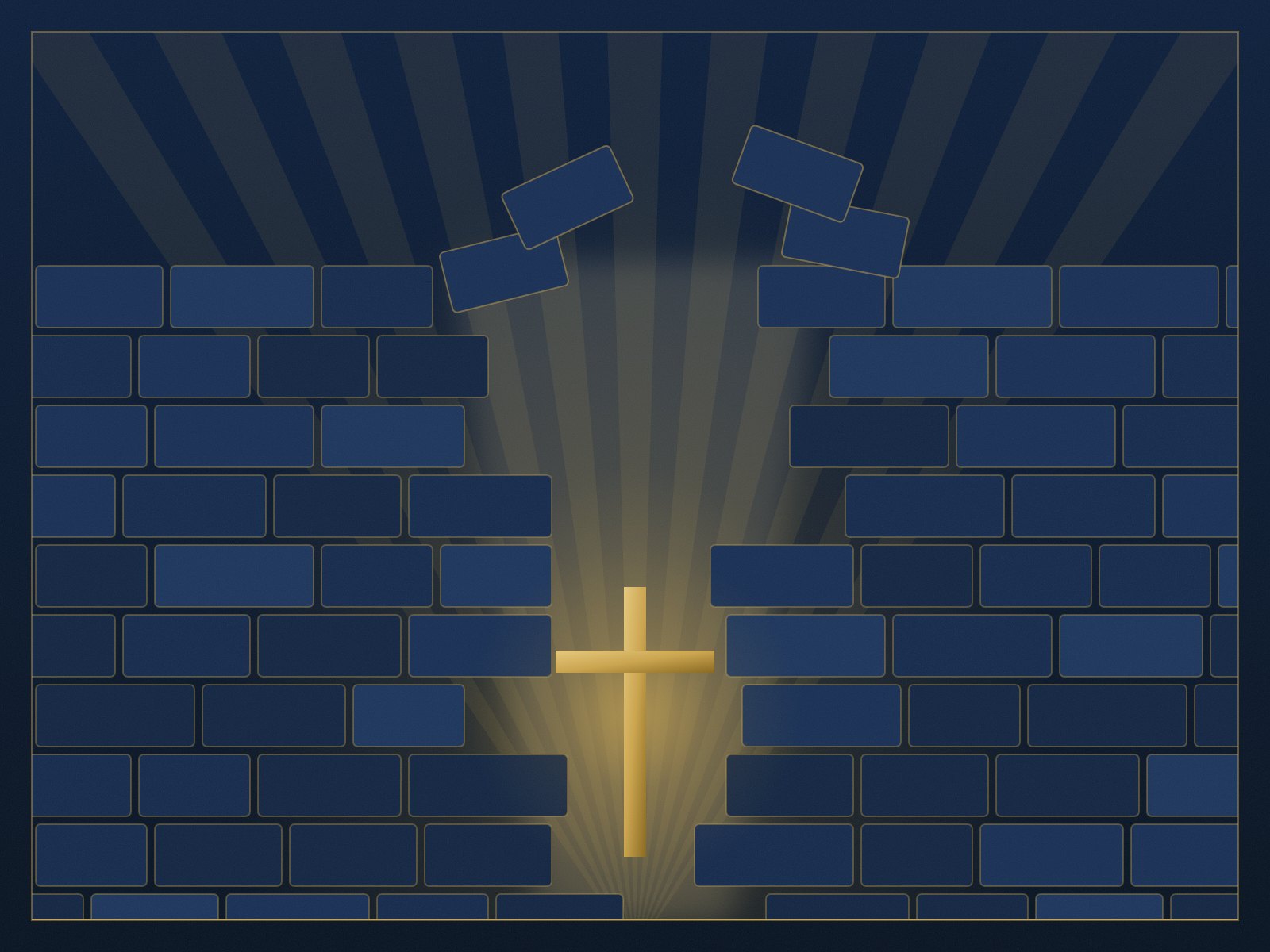
In 1914, Robert Frost published a poem about two neighbors who meet every spring to rebuild the stone wall between their properties. One neighbor has a single answer for why the wall matters: "Good fences make good neighbors." It's something his father used to say. The narrator isn't so sure. There are no cows to keep in, nothing to keep out. So he offers a better question:
"Before I built a wall I'd ask to know / What I was walling in or walling out, / And to whom I was like to give offense."
The neighbor never answers. He just keeps stacking stones, because his father stacked stones, and it never occurs to him to ask why.
I have been thinking about that poem in light of the church, because the church is a skilled builder of walls. We build them carefully, with good intentions, and we repair them every season. Most of us never ask what we are walling in or walling out. We inherited the wall. Somebody we loved and trusted told us the wall was holy, and so we keep stacking.
Some of those walls are holy. Scripture draws lines, and the church that refuses to draw any lines at all is not a church. It is a crowd. But not every wall we defend was built by God. Some were built out of honest differences in how faithful people read the Bible. Others were built from something harder to admit: the historical and personal biases of the people who handed us our faith, which we absorbed so completely that we can no longer tell the difference between their fear and God's Word.
Those walls have cost the church dearly. They have cost us people, and they have cost us witness. The tragedy is that many of us don't even recognize them as walls. We think they are part of the foundation.
At Antioch, we spent the month of August in a sermon series called Holy Tension: Faith for the Questions We'd Rather Avoid. We asked three questions. Did the Spirit stop working, or did we stop expecting Him to? What does Scripture actually say about women in leadership? And what does Peter's vision in Acts 10 mean for our LGBTQIA+ brothers and sisters in the faith? Three very different questions. But underneath all of them was the same one Frost's narrator asked: what are we walling out, and who gave us permission?
Not Every Tradition Is a Wall
Before we take down anything, we need to be honest about what deserves to stand.
I am a pastor in a historically Black Baptist church, and I love tradition. I love the hymns lined out by the deacons. I love the order of service my father kept and the one I have kept, with my own adjustments. Tradition is how one generation hands its faith to the next. It is memory with a pulse. Even Jesus went to the synagogue on the sabbath day, Luke tells us, "as was his custom" (Luke 4:16). Healthy tradition is not the enemy of the Spirit. It is often the vessel the Spirit uses.
But Jesus also confronted religious leaders who had confused the vessel with what it was meant to carry. Quoting Isaiah, He said of them, "in vain do they worship me, teaching human precepts as doctrines. You abandon the commandment of God and hold to human tradition" (Mark 7:7–8, NRSV). Jesus never condemned tradition itself. He condemned tradition that had been promoted to the level of revelation, tradition that had started doing God's job.
That is how a wall gets built. A practice becomes a preference. A preference becomes a pattern. A pattern becomes "the way we've always done it," and somewhere along the way, "the way we've always done it" becomes "the way God said it must be done." Nobody ever stands up and says, "Let's add something to Scripture." It happens one generation at a time, and the people stacking the stones sincerely believe they are being faithful.
A pastor and mentor once said something to me that I have never been able to shake: "Most people are staunch in their beliefs so as not to offend who taught them. Their loyalty isn't to the lesson, but to the teacher." Loyalty is a virtue. The Black church was built on it. But when our loyalty is to the teacher rather than the lesson, we can inherit someone else's limitation and mistake it for revelation.
Here is the irony for those of us in the Baptist tradition. Our own heritage gives us permission, even obligation, to examine what we've inherited. Walter Shurden summarized the historic Baptist principles as four freedoms, and the first of them is Bible freedom: every believer has the responsibility to read and interpret Scripture under the guidance of the Holy Spirit. The second is soul freedom: every person is directly accountable to God. Baptists were never meant to be people who simply received the walls. We were meant to be people who go back to the text and ask whether the wall belongs there.
So that is the task. Not to tear down every tradition. To ask of each one: is this barrier God's, or is it ours?
Walls Built from Discomfort
The first wall we examined in Holy Tension didn't look like a wall at all. It looked like good Baptist order.
Many churches in my tradition have absorbed some version of cessationism, the belief that the miraculous gifts of the Spirit (tongues, prophecy, healing, miracles) ceased with the apostles. The canon is closed, the argument goes, and we no longer need signs and wonders. Even churches that have never heard the word cessationist often operate by its logic. Somebody speaks in tongues and the person next to them leans over and whispers, "What did they say?" Somebody testifies that God healed what the doctors couldn't, and we clap on Sunday but don't quite believe it by Tuesday.
But when Paul lists the gifts of the Spirit in 1 Corinthians 12, he doesn't sort them into the permanent and the temporary. He puts wisdom and healing and prophecy and tongues in the same sentence, distributed by the same Spirit, "just as the Spirit chooses" (1 Corinthians 12:11). Nowhere does the text tell us that some of these would expire. That idea had to be brought to the text.
I have come to believe that cessationism is often less a conclusion drawn from Scripture than a strategy for managing discomfort. That is a pattern worth naming, because it shows up again and again. When we don't know how to handle something, we build a barrier so we never have to experience it. We take what unsettles us and declare it closed.
Even our favorite verse for keeping order has been pressed into service as a wall. "All things should be done decently and in order" (1 Corinthians 14:40) has been quoted to regulate everything from what people wear to what time service ends. But read the verse before it: "So, my friends, be eager to prophesy, and do not forbid speaking in tongues" (14:39). Paul's call for order comes attached to a command not to shut the gifts down. Order was meant to let the whole body receive the Spirit's work without confusion. We turned it into a reason to keep the Spirit at a comfortable distance.
This matters beyond spiritual gifts, because it shows us how walls work. They rarely announce themselves as walls. They show up dressed as reverence, as decency, as respectability. And the people they keep out, in this case the Spirit's own work in the gathered church, are kept out so politely that we never notice the door was closed.
Walls Built on a Single Word
The second wall is older and has done more visible harm.
For generations, 1 Timothy 2:12 has been one of the most effective walls the church has ever built: "I permit no woman to teach or to have authority over a man; she is to keep silent" (NRSV). That single verse has removed women from pulpits, stripped them of titles, and told them the call they know is on their lives doesn't count. Most of us were handed that verse long before anyone taught us how to read it.
This is a wall rooted, at least in part, in a real difference of interpretation. Faithful scholars land in different places. But when we slow down and actually study it, the wall begins to look much less like bedrock.
Paul wrote this letter to Timothy, who was pastoring in Ephesus, a city dominated by the worship of Artemis, whose temple was one of the Seven Wonders of the Ancient World and whose cult was led largely by priestesses. Acts 19 records an entire city shouting "Great is Artemis of the Ephesians!" for two hours. The letters to Timothy describe a specific, local crisis of false teaching spreading through households. Context does not erase a text, but it tells us what the text was addressing.
Then there is the word itself. The phrase "have authority over" translates a single Greek word, authenteō, which appears exactly once in the entire New Testament. When Paul speaks positively about leaders elsewhere, elders who "rule well" or those who "have charge over you," he uses ordinary words for leading. Authenteō is different. In the rare ancient sources where it appears, it carries the sense of domineering, of forcing one's will on another. Even the King James translators in 1611, centuries before modern debates about women in ministry, rendered it "usurp authority." Not hold authority. Usurp it.
And notice how Paul introduces the instruction: "I permit no woman." Not "the Lord commands." In 1 Corinthians 7, the same apostle takes care to distinguish between a command of the Lord and his own judgment: "To the rest I say — I and not the Lord" (7:12). The text doesn't force us to read "I do not permit" as a pastoral ruling for one church in one city. But it should stop us from treating one man's "I" as God's eternal "thou shalt not" for every woman in every century.
Most of all, the wall doesn't match the rest of Scripture. Deborah judged Israel without a word of apology from the text (Judges 4:4). Miriam led the whole community in worship after the Red Sea and is called a prophet (Exodus 15:20). Paul commends Phoebe as a diakonos, a deacon, and most likely entrusts her with carrying his letter to the Romans (Romans 16:1). Priscilla instructed Apollos, a gifted and already preaching man, in the way of God (Acts 18:26). Paul assumes in 1 Corinthians 11:5 that women will pray and prophesy aloud when the church gathers. The women at the tomb were the first preachers of the resurrection. And at Pentecost, Peter explained the outpouring of the Spirit by quoting Joel: "your sons and your daughters shall prophesy" (Acts 2:17).
So we have to ask the question that makes everyone uncomfortable: is this really about faithfulness to the text, or is it about control? When we build an entire doctrine on one rare word in one letter to one city, and quietly step around Deborah, Miriam, Phoebe, Priscilla, and the women of Pentecost, we may be protecting something other than Scripture. We may be protecting comfort, familiarity, and power staying where it has always been.
If a woman could carry the Word in her womb, why can't she carry it in her mouth?
Walls Built from Inheritance
That question leads us somewhere the Black church knows painfully well.
The church has a long history of deciding who is permitted to serve, and of being wrong about it. We have excluded people of certain races from certain roles, citing Scripture. We have excluded women from the pulpit, citing Scripture. We have drawn hard lines around the divorced, the addicted, and the broken. In most of those cases, the church eventually recognized that the barrier was ours and not God's. We had taken our reading of the text, built a wall with it, and called the wall holy.
The Black church does not have to imagine what that looks like. We were on the other side of the wall. In 1807, a missionary society in London published an edited Bible for enslaved people in the British West Indies, with most of the Exodus story removed. They kept the verses that told slaves to obey their masters. They cut the story of a God who hears the cry of the oppressed and brings them out of bondage. Those who edited it believed they were spreading the gospel. What they were actually doing was protecting an economic and racial order and calling it Christianity.
Enslaved people on this side of the Atlantic, handed the same kind of preaching, read past the wall. They found Moses anyway. They sang "Go Down, Moses" in the fields and found a God who was not on Pharaoh's side. The Black church was born, in a very real sense, out of people refusing to accept a reading of Scripture designed to keep them in their place.
That is our inheritance. It means we, of all people, should be suspicious when the Bible is read in ways that conveniently keep certain people at a distance. We know from experience that sincere Christians can build walls out of their own biases and genuinely believe God laid every stone.
It also means we have to ask the harder question of ourselves. If our ancestors could see the wall that was built around them, what walls have we built around others?
Reading the Hardest Texts Honestly
This brings us to the conversation the church most wants to avoid: the place of our LGBTQIA+ brothers and sisters in the life of the church.
In August, Antioch released a pastoral statement on human dignity, belonging, and ministry participation regarding LGBTQIA+ persons. I want to be careful here about what that statement does and does not do, because integrity requires it.
The statement does not attempt to settle the question of whether LGBTQIA+ identity or expression is sin. That is a serious question, and it deserves its own time and pastoral care. Faithful people who love God and take Scripture seriously have read the same texts and arrived at different conclusions on it, within our congregation, within the Baptist tradition, and throughout the global church. This is not a battle between people who take the Bible seriously and people who don't. It is a conversation among people who all take the Bible seriously and are arriving at different places.
What we owe one another is honest work with the texts. So let me show it, briefly.
Genesis 1–2. The traditional reading sees the union of male and female in creation as God's design for human sexuality. Contemporary scholarship acknowledges that pattern while noticing something prior to it: before the text says anything about gender, God breathes into the dust and the human becomes a living soul, nephesh. If God is not a man (Numbers 23:19) and God is Spirit (John 4:24), then the image of God in humanity cannot be primarily about gender or sexuality. Soul precedes sex.
Genesis 19. Sodom has long been cited as judgment on same-sex behavior. But Scripture offers its own commentary: "This was the guilt of your sister Sodom: she and her daughters had pride, excess of food, and prosperous ease, but did not aid the poor and needy" (Ezekiel 16:49, NRSV). Many scholars read the story as judgment on violent inhospitality and exploitation, not consensual relationship.
Leviticus 18:22 and 20:13. These are read traditionally as clear and enduring prohibitions. But every Christian has to answer a question about the Holiness Code: by what principle do we carry some of its laws forward and release others? We don't keep its dietary laws, its fabric restrictions, or its civil penalties. An honest reading has to name the principle we use.
Romans 1:26–27. This is the most cited New Testament text in the conversation. The traditional reading sees a clear condemnation of same-sex behavior as contrary to nature. Contemporary scholarship places it within Paul's indictment of Gentile idolatry and argues that he is describing excess, exploitation, and the abandonment of God. Committed same-sex covenant relationships were not a recognized category in his world.
1 Corinthians 6:9 and 1 Timothy 1:10. These hinge on two Greek words, arsenokoitai and malakos, rendered very differently across translations. The King James translates malakos as "effeminate." The NRSV renders the words "male prostitutes" and "sodomites." The updated NRSVue translates arsenokoitai as "men who engage in illicit sex" and adds a footnote that reads simply: "Meaning of Greek uncertain." That footnote is not the conclusion of advocates. It is the admission of the translators themselves.
I offer these readings not to suggest that the conversation has no stakes. It has enormous stakes. I offer them because a church that has been told the answers are simple is less prepared to love across difference than a church willing to sit with the real complexity of the text.
Here is where interpretation and bias meet. When the texts are honestly contested, when translators themselves admit uncertainty, why has the church been so certain about keeping people out? Why have we reserved our most confident judgments for the people we were most uncomfortable with? That is not a question about interpretation anymore. That is a question about us.
And while the sin question remains open, the questions that come before it do not. Every person is made in the image of God. Salvation belongs to all who trust in the finished work of Jesus Christ, and nothing else. And "the gifts and the calling of God are irrevocable" (Romans 11:29). If God has gifted and called a person, that gift and calling do not dissolve because of who that person loves. We do not believe we have the authority to close a door God has opened.
The statement also holds two commitments together that many people assume must be pulled apart: a high view of Scripture and a high view of lived experience. Some hear that and worry we've placed experience over the Bible. But the Bible itself shows us the church making exactly this kind of discernment. When Peter returned to Jerusalem and was criticized for eating with Gentiles, he didn't win the argument with a new verse. He told them what he had seen in Cornelius's house: "If then God gave them the same gift that he gave us when we believed in the Lord Jesus Christ, who was I that I could hinder God?" (Acts 11:17, NRSV). And at the Jerusalem Council, the church weighed Peter's testimony, and that of Paul and Barnabas, about what God was doing among the Gentiles alongside the Scriptures (Acts 15). The same Spirit who inspired the text was moving in the people they were reading it alongside.
None of this requires anyone to abandon their convictions. It requires us to ask whether our convictions have become a wall.
Common or Communion
Which brings us back to Acts 10, where the question of walls was settled once before.
Peter was a faithful man. He had walked with Jesus in the flesh, watched the miracles, seen the risen Lord. And when God showed him a sheet full of animals the law had called unclean and said, "Get up, Peter; kill and eat," Peter refused. "By no means, Lord," he said, "for I have never eaten anything that is profane or unclean" (Acts 10:14). Peter told God no and called it devotion. Three times.
God answered, "What God has made clean, you must not call profane" (10:15). And when Peter arrived at the house of Cornelius, a Roman centurion whose prayers and generosity God had already honored, he finally understood. The vision was never about food. It was about people. "God has shown me," he said, "that I should not call anyone profane or unclean" (10:28).
The Greek word translated "unclean" there is koinos, and its most basic meaning is simply "common," ordinary, outside what is set apart. The King James renders it, "I should not call any man common or unclean." But that same root gives us one of the most treasured words in the New Testament: koinonia. Fellowship. Communion. Deep, shared life.
The very word that had been used to keep people at a distance shares a root with the word for the deepest kind of belonging. God was never asking Peter to lower the standard of holiness. He was asking Peter to stop mistaking exclusion for holiness. The same root that built a wall could just as easily build a table.
And notice the order of events. God spoke to Cornelius before God ever spoke to Peter about him. God was already moving toward the person Peter had written off. Peter wasn't opening a door God had closed. He was catching up to a door God had already opened.
That is the hope and the warning of every wall we build. God is not confined by them. The Spirit is already on the other side, already moving among the people we've kept out, already pouring out gifts we have no authority to revoke. The only question is whether we will be like Peter, humble enough to admit we were wrong, or like Frost's neighbor, stacking stones because our fathers stacked stones.
The Main Thing
So how should a church decide what to keep and what to take down?
I have come to hold two New Testament texts as the primary measures of faithfulness. In Matthew 25, when Jesus describes how He will judge the nations, He does not ask about doctrinal precision. He asks whether we fed the hungry, gave water to the thirsty, welcomed the stranger, clothed the naked, cared for the sick, and visited the imprisoned. The judgment seat is not a theology exam. It is an accounting of how we loved. And in Galatians 5, when Paul describes the evidence of a life surrendered to the Spirit, he names love, joy, peace, patience, kindness, generosity, faithfulness, gentleness, and self-control. Not uniformity on every contested question. Fruit.
These texts don't settle every debate. But they tell us clearly what the main thing is, and the main thing is love.
Years ago, in a rough season of my life and ministry, I sat in a conference session and heard a woman preach in a way that broke me open. I could not tell you today exactly what she said. I can tell you that I wept uncontrollably, and that the Holy Spirit met me through her in a way I needed more than I knew. In the very next session, I learned that she is a same-gender-loving woman married to a woman. And I sat there with a question I didn't choose and couldn't shake: did what God had just done in me get undone by what I had just learned about her?
I'm not going to pretend I resolved that question that afternoon. But I know what the Spirit did in that room was real. It didn't become less real when I knew more about her. And I learned that day that my approval was not required for God to use her.
That is the lesson of every wall in this essay. The Spirit did not need cessationists' permission to keep moving. God did not need the church's permission to call Deborah, Phoebe, and Priscilla. God did not need Peter's permission to save Cornelius. And God does not need ours.
What God asks of us is not permission. It is room.
There is a better wall-builder in Scripture than any of us. Paul writes that Christ "is our peace; in his flesh he has made both groups into one and has broken down the dividing wall, that is, the hostility between us" (Ephesians 2:14, NRSV). The cross was not God building a wall to keep the wrong people out. It was God tearing one down so that people who were far off could be brought near. Every wall the church builds in the name of holiness has to answer to that one: the wall Jesus broke down with His own body.
Frost's narrator had it right: "Something there is that doesn't love a wall, / That wants it down." I believe that something is the Spirit of God. And I believe that the church that wants to recover its witness in this generation will have to do what Peter did on the rooftop in Joppa: stop arguing with God, admit what we inherited, go to the house we were taught never to enter, and discover that God got there first.
Land where you land on the questions that remain. But love how Jesus loves.
That is not the absence of a standard. It is the highest one we have.
Christopher K. Wesley, M.Div., is the Senior Pastor of Antioch Fellowship Missionary Baptist Church in Dallas, Texas, and Director of EMERGE for the National Baptist Convention of America International, Inc. He holds the Master of Divinity from the Samuel DeWitt Proctor School of Theology at Virginia Union University.