Lover of God, god's People
and god's Word
The Essays
Long-form writing on theology and culture from Pastor Chris Wesley.

When the Crown and the Cross Became One
Most Americans encounter Christian nationalism as a distinctly modern problem — a product of cable news, social media algorithms, and the culture wars of the last few decades. But what if the story is much older than that? What if the fusion of faith and national identity that animates so much of today's political religion isn't a new invention, but the resurrection of something that has been tried before — with consequences that reshaped the entire Western world?
In his landmark work Turning Points: Decisive Moments in the History of Christianity, historian Mark Noll identifies the English Act of Supremacy of 1534 as one of those hinge moments in Christian history when everything changed. Understanding what happened in that moment — and why it happened — may be one of the most important things American Christians can do right now.
And if you want to understand what is happening in America today, I'd argue no tradition is better equipped to read this moment than the Black church. Because the Black church has always known, in its bones, what happens when Christianity becomes the religion of the empire. We've been living with the consequences for four hundred years.
A King, a Pope, and a Marriage That Changed Everything
The surface story is almost soap opera simple. King Henry VIII wanted out of his marriage to Catherine of Aragon. The Pope wouldn't grant an annulment. So Henry did what powerful men have always done when institutions don't give them what they want: he changed the institution.
In 1534, with the stroke of a parliamentary pen, the Act of Supremacy declared Henry VIII the "Supreme Head of the Church of England," severing England's centuries-long relationship with the Roman Catholic Church. At first glance, this looks like a theological rupture. But Noll's deeper analysis reveals something more troubling and more instructive: this was not primarily a spiritual decision. It was a political one.
Henry wasn't converting. He wasn't embracing the theology of Luther or Calvin. He wasn't moved by the Spirit to reformation. He was consolidating power. And the church — the Body of Christ — became the instrument through which that power was consolidated.
The Black church has its own version of this story, and it is far less distant. The same Christianity that enslaved Africans on these shores was a Christianity that had been captured by empire. The slaveholder's Bible was not a corrupted scripture — it was scripture filtered through the logic of power. Passages about obedience were preached to the enslaved. Passages about liberation were never mentioned. The crown had its theology, and the church delivered it.
That is what capture looks like. And it is always, always dressed in the language of devotion.
The Larger Force: When Nations Started Claiming Jesus
What makes the Act of Supremacy more than a scandalous footnote in royal history is that it represents a major tectonic shift in how Christianity was organized and understood in the West. The early Reformers — Luther, Zwingli, Calvin — had hoped, naively perhaps, that the church could be reformed while remaining universal. One church, reformed and renewed, for all of Christendom.
That vision died somewhere in the mid-sixteenth century. What replaced it was a new model: national Christianity. English Christianity. German Christianity. Scandinavian Christianity. Each one shaped by the particular political needs and cultural anxieties of its host nation. Each one, in some sense, a church in service of the state.
This shift was not accidental. Several forces conspired to make it possible:
Politically, monarchies across Europe were consolidating power in new ways. The Tudor dynasty in England, the Catholic monarchs in Spain — rulers everywhere were learning to use religion as a tool for unifying fractured populations under a single national identity.
Economically, there was deep resentment over money flowing out of local communities into Rome. The church had become, in the eyes of many, a foreign extraction machine — taking tithes from English peasants and depositing them in Italian coffers.
Socially, the old feudal order was crumbling. New merchant classes were rising. Urban centers were growing. The clergy's authority was weakening. People were searching for new anchors of identity and belonging.
Intellectually, the printing press had changed everything. Ideas — including dangerous ones — could spread faster than any bishop could contain them. Renaissance humanism was teaching Europeans to go back to original sources, which meant reading the Bible for themselves and asking hard questions about what the church had become.
Henry VIII didn't create these conditions. He exploited them. And in doing so, he gave the world a template that has been used over and over again: capture the church, claim divine sanction, and use the spiritual loyalty of believers to serve political ends.
The Price of Fusion
One of the most sobering aspects of this history is what happened to those who refused to go along — and none refused more consequentially than Sir Thomas More.
More was not a marginal figure. He was Henry's Lord Chancellor, the highest legal office in England, one of the most powerful men in the kingdom and one of the most celebrated intellectuals in Europe. Erasmus counted him as a friend. He had served Henry loyally for decades. He was, by any measure, an insider — and insiders rarely pay the price of refusal.
But when the Act of Supremacy demanded that More swear an oath acknowledging Henry as the Supreme Head of the Church of England, he refused. Not loudly. Not with revolutionary language. He simply went silent — declining to swear the oath, declining to explain himself, invoking the ancient legal principle that silence cannot be construed as treason. For fourteen months he sat in the Tower of London, stripped of his offices, his property transferred, his family pressured to convince him to comply. Friends came to urge him to just say the words. Nobody would know what he truly believed in his heart. What would it cost him to bend?
More understood exactly what it would cost him — not in the bending, but in the breaking. He understood that once the state could define the terms of your faith, it owned your conscience. And he would not sell his conscience, not even to a king he had served faithfully, not even to save his own life.
He was beheaded on Tower Hill on July 6, 1535. His last recorded words were characteristic — wry, clear-eyed, and utterly unintimidated. He told the crowd he died "the King's good servant, but God's first."
That sentence is worth sitting with. He did not deny his loyalty to Henry. He did not call the king a tyrant from the scaffold. He simply named the order of things as he understood them: king, yes — but God first. And when the two came into conflict, there was no real choice to make.
The Act of Supremacy didn't just reorganize ecclesiastical power. It created a new kind of loyalty test. To be English was to be Anglican. To resist the crown's religious authority was not merely political dissent — it was treason, punishable by death. Religion had been weaponized into a mechanism of exclusion, coercion, and conformity.
Faith was no longer simply a relationship between a person and God. It had become a badge of national belonging — and those who couldn't or wouldn't wear that badge were cast as traitors, heretics, and enemies of the people.
The Black church knows what it costs to refuse this bargain. The preachers who read Exodus when they were supposed to be preaching Romans 13. The congregations that held freedom meetings in secret. The theologians who insisted that the God who freed Israel had something to say to a people in chains in America. They paid for that resistance in real ways — with their freedom, and sometimes with their lives. But they also preserved something the state church had surrendered: the prophetic independence that makes the church the church.
The Echo We're Living In
I am not a historian who believes that history simply repeats itself. But I do believe, as the preacher's tradition has long taught, that patterns recur because human nature is consistent, and because the temptations of power are remarkably unimaginative.
When I study the Act of Supremacy and then look at the contours of Christian nationalism in twenty-first-century America, I cannot help but notice the family resemblance. And this time, I want to name names — because vagueness is a luxury we can no longer afford.
Religion as a tool of political authority — and moral redefinition. Henry VIII didn't become a different kind of Christian; he made Christianity answer to the crown. He didn't need genuine faith — he needed the church's institutional legitimacy and the loyalty of its members. But there is something even deeper at work here than political convenience. When empire captures the church, it doesn't just gain an ally. It gains something far more dangerous: the power to move the ethical goalposts.
This is, in the most literal theological sense, the temptation of the Garden. When the serpent said to Eve, you will be like God, knowing good and evil, the seduction wasn't knowledge itself — it was the seizure of moral authority. The power to define what is righteous and what is wicked. What is holy and what is profane. Who is in and who is out. That is the original sin: not merely disobedience, but the human grasping after the divine prerogative to determine good from evil. When empire co-opts the church, it commits this sin at a civilizational scale — and it uses the language of faith to do it.
Henry VIII was, by any honest accounting, a man of profound moral disorder. He executed two of his six wives. He beheaded advisors who crossed him, including the very Thomas More whose conscience he could not purchase. He was driven by vanity, appetite, and the unshakeable conviction that his desires were God's desires. And yet, with the church under his authority, he could do all of this while remaining, officially, the Supreme Head of the Church of England. The church didn't check his power. It sanctified it. It moved the moral line to wherever Henry needed the moral line to be.
Today we watch the same dynamic play out in real time. Donald Trump has publicly questioned whether he is personally Christian, and yet he has positioned himself as the singular defender of Christian civilization in America — selling Bibles, hosting evangelical prayer gatherings at the White House, and invoking God's protection over his political movement with the ease of someone who knows exactly what that symbolism is worth. He is, by the measure of any traditional Christian ethical framework, among the most morally compromised public figures to ever hold the office of the presidency — a man defined by dishonesty, cruelty, the exploitation of the vulnerable, and the discarding of anyone who ceases to be useful. And yet, cloaked in the borrowed garments of Christian identity, he has convinced millions of believers that his enemies are God's enemies, that his agenda is God's agenda, that resistance to him is resistance to the faith itself. He is not using Christianity to encounter God. He is using Christianity to redefine what God requires — to move the goalposts so that his own moral failures disappear from the field entirely. That is not faith. That is the serpent's oldest trick.
And it is not only Trump. Pete Hegseth, serving as Secretary of Defense, has openly used the language of holy war — framing American military power in explicitly Christian crusader imagery, speaking of "taking back" a Christian nation, invoking God's name over the machinery of state violence. This is not pastoral theology. This is a crown demanding the church's blessing on its sword — and then calling the sword holy.
The printing press then; social media and partisan media now. The printing press democratized information in the sixteenth century — and with it, democratized both reformation and propaganda. Ideas that would have died in a monastery were now circulating in every village. What the press made possible, demagogues and reformers alike rushed to exploit. Today, social media and twenty-four-hour cable news networks with no pretense of neutrality play the same role. A Christian nationalist message that would have stayed in a megachurch parking lot in 1995 now reaches millions within hours. Fox News has functioned, in this moment, less as a news organization and more as a theological clearinghouse — shaping what millions of Americans believe God wants for the country. The algorithms of Facebook, YouTube, and X don't just spread information; they amplify outrage and accelerate radicalization, just as the unchecked pamphlet presses of the Reformation era spread theological chaos alongside genuine renewal. The mechanism is different. The dynamic is the same.
National identity bound to religious identity. In Tudor England, loyalty to the crown meant loyalty to the crown's church. Dissent from one was dissent from both. Today, Christian nationalism has erected the same wall. To be a "real American" — in the framing that now dominates significant parts of our political discourse — is to be Christian in a particular, culturally specific way. Not the Christianity of the beatitudes. Not the Christianity of the prophets. The Christianity of the flag, the gun, the border wall, and the binary certainty that some people belong here and others do not. Those who are Muslim are immediately suspect. Those who are secular are dismissed as dangerous. Those who are Black and Christian and yet refuse to sign on to this project are, at best, confused — and at worst, traitors. The loyalty test Henry created in 1534 has been reissued with new paperwork.
The rejection of the universal church. One of the casualties of the Act of Supremacy was the idea of a church that transcended national and ethnic boundaries — a community where, as Paul wrote to the Galatians, there is neither Jew nor Greek, slave nor free. What replaced it were churches that reflected and reinforced national identity. Christian nationalism today makes the same trade, and it is just as bad a deal. The Gospel is not American. Jesus was not born in the West. The church that spread across the Roman Empire was not defined by its allegiance to Caesar — it was defined by its resistance to Caesar's claim on ultimate loyalty. The moment the church becomes the chaplain of any empire, it has exchanged its birthright for a seat at a table that will eventually be flipped.
Anxiety as accelerant. The Reformation's nationalist turn didn't happen in a vacuum. It happened in a moment of profound social disruption — when old orders were collapsing, when economic pressures were intensifying, when people felt unmoored from familiar structures of meaning. Henry didn't create that anxiety; he channeled it. The same dynamic is at work today. Christian nationalism has risen precisely as many white Americans experience rapid demographic change — a country where they will no longer constitute the majority — alongside economic dislocation, declining institutional trust, and a felt loss of cultural centrality. Religion becomes the vehicle through which that anxiety is organized, and the church becomes a fortress rather than a mission. The Black church has watched this process with a particular kind of recognition. We have always known that America had an identity rooted in racial hierarchy. What is new is the degree to which that hierarchy is now being defended in explicitly religious language — as though God ordained not just salvation, but the particular social arrangement that some Americans are watching slip away.
What the Black Church Knew That the State Church Forgot
There is a reason the Black church produced Harriet Tubman and Frederick Douglass and Fannie Lou Hamer and Martin Luther King Jr. and John Lewis and Prathia Hall. It is not because Black Christians are inherently more righteous. It is because the Black church was never captured.
When enslaved Africans took the Christianity of their oppressors and transformed it — finding in Moses a God who sides with the enslaved, finding in the Resurrection a power no earthly master could cancel, finding in the Psalms a language for lamentation and hope that the slaveholder had never intended them to discover — they were doing something theologically profound. They were refusing to let the empire define what the Gospel meant.
The invisible church. The hush harbor. The spirituals with their double meanings. The Black preacher who could say one thing in front of white observers and something entirely different in the language of the congregation — this was not deception. It was the preservation of a faith the empire had tried to weaponize, returned to its original power.
The Black church has always understood that the Gospel is subversive. It does not bless the powerful in their power. It speaks good news to the poor. It proclaims release to the captive. It sets at liberty those who are oppressed. You cannot do that if the government is signing your checks or the politician is sitting in your front pew with a camera crew.
This is the tradition's most urgent gift to the broader American church in this moment: the testimony that you can survive without the empire's favor — that, in fact, you preach better without it.
What the Church Lost — and What It Has to Lose Again
Here is what I find most heartbreaking about the history of 1534: when Henry VIII made himself the Supreme Head of the Church of England, the church lost something it has never fully recovered — its prophetic independence.
A church that answers to the state cannot speak truth to power. A church that is funded by the crown cannot challenge the crown's injustices. A church that has fused its identity with the nation cannot bear witness against the nation's sins. It becomes, instead, the nation's chaplain — offering benedictions to its wars, blessings to its hierarchies, and comfort to the powerful while the poor wait for their turn that never comes.
The prophetic tradition — from Amos to Isaiah to John the Baptist, from Nat Turner to Sojourner Truth to Howard Thurman to James Cone — has always understood that the church's power comes precisely from its refusal to be captured. It is the freedom from national allegiance that gives the church the authority to say, "Thus saith the Lord," even when the Lord's word is deeply inconvenient to those in power.
When the church becomes the arm of the nation, it loses the only thing that made it distinctive: its allegiance to a Kingdom that is not of this world.
A Word to the Church
I write this not as an outside critic but as a pastor who loves the church deeply and serves it with everything I have. I write it because I believe the church is always one generation away from making the same mistakes it made before — not because we are evil, but because we are human, and the temptations of power and belonging are ancient and persistent.
I write it, too, as a son of the Black church — a tradition that has already paid every price this moment is trying to charge, and survived. We have been through this before. We know what it looks like when Christianity is used as an instrument of domination. We know what it costs to resist. And we know, better than anyone in this country, that the Gospel does not need the empire to be true.
The English Reformation reminds us that you don't have to be a tyrant to lose your prophetic witness. You just have to let someone more powerful than you define what your faith means, what your church is for, and who belongs.
The question every congregation — every believer — must answer in this moment is the same one Thomas More answered on the scaffold, the same one the hush harbor congregation answered in theirs: When the crown demands the allegiance that belongs to Christ, what will you do?
More answered with his life and eleven words: the king's good servant, but God's first. The Black church answered with four centuries of resistance, survival, and witness. Both answers cost something. Both answers preserved something that no empire could manufacture or replace.
History suggests that the consequences of getting that question wrong are long, slow, and costly. But history also shows us that the Black church — against impossible odds, in the belly of the beast — got it right. Not perfectly. Not without cost. But right enough to produce a tradition of resistance, resilience, and prophetic witness that the world is still drawing from.
That is the hope I carry into this complicated, anxious moment. Not optimism — hope. The kind that has roots deep enough to hold through the storm. The kind that was forged not in comfort, but in the fire.

Where Do We Go From Here
In 1967, Martin Luther King Jr. published what would become his final book. He titled it Where Do We Go From Here: Chaos or Community? The Civil Rights Act had passed. The Voting Rights Act had passed. The legislative mountains had been moved. And King, rather than celebrating, was asking the harder question that the victories had now exposed.
The removal of the barrier, he understood, does not automatically produce the just society. Dismantling is one kind of work. Building is another — slower, less dramatic, more demanding, and in many ways more dangerous, because it requires the movement to become something different than it was. Protest is clarifying. Institution-building is complicated. King saw the moment clearly: the freedom to pursue justice in new arenas had arrived, and the question was whether the movement had the theological imagination and organizational courage to follow it there.
The Black church is standing at a similar crossroads today.
Artificial intelligence is not a future concern. It is already here — reshaping labor markets, concentrating economic power, influencing who gets bail and who doesn't, shaping the information environment that our congregants navigate every single day. The communities Black churches serve are already being affected. And the church that waits for a more convenient moment to engage this reality is not protecting its people from it. It is simply leaving them to face it alone.
The question is not whether the Black church will encounter artificial intelligence. That question has already been answered. The question King was asking is the right one: Where do we go from here?
We Have Been at Crossroads Before
The Black church did not survive four centuries of American history by avoiding difficult terrain. It survived by moving through it — by taking the tools and conditions of each moment and pressing them into the service of a mission that outlasted every single one of them.
The invisible church of the antebellum South turned the slaveholder's Christianity against itself, finding in the Exodus a God the slaveholder had not intended them to meet. The Black church of the Great Migration built institutions — banks, newspapers, hospitals, schools — in cities that had not prepared for the arrival of six million people and had no intention of welcoming them. The church of the Civil Rights Movement weaponized the Constitution, the courts, the television camera, and the spiritual discipline of nonviolent resistance to dismantle a legal architecture of oppression that had stood for a hundred years after emancipation.
In each of those moments, the church faced a version of the same question: What does faithfulness look like right now, with these tools, amid these pressures? The answer was never avoidance. It was never uncritical adoption either. It was discernment — the willingness to engage the moment on the mission's terms rather than the moment's terms.
That is the tradition we are inheriting. And it is exactly the tradition we need.
The Gap Is Already Costing Us Something
The Black church's technological lag is not cultural indifference. It is the predictable result of structural inequality that has always distributed access to capital, infrastructure, and innovation unevenly by race. Every major technological shift in American history has reached Black communities later, with less support, and configured to serve someone else's needs first. This one is no different.
The digital divide is documented and persistent. Lower rates of broadband access, device ownership, and digital literacy in Black communities — particularly in lower-income and rural areas — mean that Black churches in those communities are navigating an AI moment with fewer resources than the institutions they are trying to keep pace with. This is not new. But the stakes have never been higher.
Artificial intelligence is not simply a faster way to do familiar things. It is a structural reorganization of how labor works, how information moves, and how economic power accumulates. The workers most exposed to automation are those concentrated in transportation, manufacturing, retail, and service industries — sectors where Black workers have been historically overrepresented, not by choice, but by the long architecture of occupational segregation. The McKinsey Global Institute has documented that Black workers face an above-average risk of job displacement from automation for exactly this reason.
The communities most at risk from AI's disruption are the communities the Black church was built to serve. Which means this is not a technology question. It is a ministry question. And the Black church has never had the luxury of treating ministry questions as optional.
There is a deeper dimension to this gap worth naming plainly. Black people represent roughly 13 percent of the American population and approximately 3 percent of the technology workforce. AI systems are not neutral instruments. They reflect the values, assumptions, and blind spots of the people who build them. When Black voices are absent from the rooms where these systems are designed, the systems carry that absence forward — into hiring algorithms, into criminal risk assessments, into medical diagnostic tools, into the search results that shape what our children believe is true about themselves and their world. Safiya Umoja Noble documented this in Algorithms of Oppression. Virginia Eubanks documented it in Automating Inequality. The research is not ambiguous. Systems built without us tend to work against us.
This is not a reason for despair. It is a reason for urgency.
The Stewardship Argument
The Black church has always been required to do more with less. That history is painful. It is also, in this particular moment, a kind of preparation.
The most immediate opportunity that AI offers Black congregations is administrative — and the word "administrative" undersells what that actually means in practice. In the average Black church, pastoral care, sermon preparation, community programming, communications, financial management, and event coordination fall on small staffs or volunteer teams who are already overextended. The pastor who spends two hours on a newsletter is not spending those two hours on the hospital visit. The administrator buried in scheduling logistics is not building the community partnerships that the church's mission requires.
AI tools can meaningfully reduce that burden. Generative AI can assist with drafting correspondence, grant applications, social media content, and educational materials. Scheduling platforms with AI integration can reduce the friction of coordinating volunteers and managing calendars. Financial tools can help treasurers make better-informed decisions with limited resources. None of this is glamorous. All of it matters.
The goal is not a more efficient church. It is a more available church — one whose leaders have more time and energy for the ministry that no technology can replace, because AI is carrying some of the load that was consuming them. Time returned from administrative work is time returned to presence. And presence is what the church has always had to offer that nothing else can replicate.
Howard Thurman understood this. His foundational argument in Jesus and the Disinherited was that Jesus ministered from a position of solidarity with those who had their backs against the wall — and that the church's calling is to embody that same solidarity. That calling cannot be delegated to an algorithm. In an era of algorithmic impersonality — where automated systems make consequential decisions about credit and bail and healthcare and housing without human accountability or compassion — the Black church's insistence on the full humanity of each person it encounters is not a relic of a pre-digital age. It is a prophetic act. It is what makes the church the church.
But Thurman's vision of presence-centered ministry is only sustainable if the people doing it are not drowning in work that a machine could do. That is the stewardship case for strategic AI adoption. Not efficiency for its own sake. Presence made possible.
The Prophet's Obligation
The Black church cannot engage artificial intelligence without raising its prophetic voice about the conditions under which that technology is being built and deployed. This is not a sidebar to the conversation. It is the center of it.
Consider water.
The data centers that power large AI systems consume extraordinary amounts of water for cooling — a single facility can consume millions of gallons annually. This is not an abstraction. Sand Branch is a historically Black community located near Dallas, Texas — not far from where I pastor — that to this day lacks access to a reliable, clean water supply. That reality echoes what the nation watched unfold in Flint, Michigan, beginning in 2014. Sand Branch is not an anomaly. It is a pattern. And the pattern is this: communities of color, with less political power and fewer resources, are systematically left without basic infrastructure while new technologies expand their demands on the very resources those communities lack.
The expansion of AI requires water. The people least likely to have clean water are the people most likely to live near the infrastructure that AI requires and least likely to share in its benefits. That is not irony. It is a moral indictment. And the Black church — which has always understood that the Gospel has something to say about who gets water and who doesn't — cannot embrace AI without also raising its voice about what that infrastructure is costing the people closest to the ground.
The same prophetic obligation applies to the question of bias. AI systems are not neutral. They are trained on historical data — which means they are trained on historical injustice. Facial recognition systems have documented higher error rates for darker-skinned faces. Criminal risk assessment algorithms encode the racial disparities of a justice system that was never designed to be just. Hiring platforms trained on historical patterns of employment perpetuate the exclusions that produced those patterns. These are not bugs. They are the predictable outcomes of systems built without sufficient accountability to the people most likely to be harmed by them.
And there is a subtler dimension to this that the Black church should take seriously. The large language models becoming central to everyday information access reflect the values, priorities, and assumptions of their developers in ways that are often invisible to users. When those systems are shaped by ideological environments that protect dominant perspectives, they may struggle to generate content that prophetically challenges those perspectives. A tradition whose survival has always depended on speaking truth to power cannot afford to outsource its voice to systems that may be designed, however subtly, to protect power.
Cornel West wrote in Prophesy Deliverance! that the Black prophetic tradition is distinguished by its willingness to speak the truth about what is, in the name of what ought to be. That willingness is not something AI can replicate or replace. It is the soul of the tradition. And it must be brought to bear on AI itself — on who builds it, who controls it, who profits from it, and who is being asked to simply absorb the cost.
Boldly Going
There is a phrase from a different cultural tradition that keeps finding its way into my thinking about this moment. In Star Trek, the mission of the Enterprise is defined in its opening: to boldly go where no man has gone before. The crew does not know what they will encounter in uncharted space. They go anyway — not recklessly, but with curiosity, with values intact, with a commitment to the mission that survives every new encounter with the unknown.
That is the posture the Black church needs in the age of artificial intelligence. Not the posture of the institution that waits until the territory has been mapped by someone else and arrives late, poorly resourced, and on someone else's terms. Not the posture of the institution so afraid of losing itself that it refuses to move at all.
The posture of a people who have always had to navigate uncharted territory. Who have always had to ask what faithfulness looks like in a moment nobody prepared them for. Who have survived every crossing because the mission was stronger than the conditions.
The Black church needs to invest in AI literacy — in its congregations, its communities, its young people who could be in the rooms where these systems are built rather than simply subject to them. It needs to partner with schools and workforce programs to create pathways into the technology sector for Black youth and adults. It needs to develop the institutional capacity to evaluate AI tools critically — to ask whose values are embedded in them and to make intentional decisions about what it will and will not adopt.
It needs to advocate — at the level of policy and governance and public accountability — for AI development that is transparent, for algorithmic systems that can be audited and challenged, for environmental regulation of infrastructure expanding on the backs of communities that have already given enough. The Black church has always understood that faithful ministry includes advocacy. Sand Branch needs water. That is a ministry issue. It is also an AI issue. The church should be saying so, loudly.
And it needs to protect, fiercely and deliberately, what AI cannot touch. The deacon who sits with the widow. The mothers' board surrounding a grieving family. The pastor at the graveside speaking resurrection into the face of death. The congregation that shows up — in body, in presence, in the full weight of its humanity — because showing up is what the church does. These are not ministry tasks to be optimized. They are the ministry. Every AI adoption decision must be evaluated against that conviction.
The Answer to King's Question
King's question was never really about strategy. It was about identity. It was asking: after everything that has been endured, everything that has been built, everything that has been sacrificed to get here — who are we, and what do we stand for, when the next hard thing arrives?
The Black church's answer, across four centuries, has been consistent even when the conditions were not. We are the people who show up. We are the people who tell the truth. We are the people who hold together what the world is trying to tear apart — lament and hope, grief and praise, the reality of what is and the conviction of what God intends.
Artificial intelligence does not change that answer. It tests it. It asks the church whether the identity that survived slavery and Jim Crow and redlining and every other attempt to diminish it will also survive the seductions of efficiency, relevance, and technological cool. Whether the church will arrive at the AI table with its prophetic voice intact or whether it will trade that voice for a seat.
The Black church has stood at crossroads before.
Every generation has been required to ask what faithfulness looks like in this moment, with these tools, amid these pressures.
The question is the same in the age of artificial intelligence. What has changed is the urgency.
The way forward is what I have called prophetic partnership: a relationship with AI that is strategic without being naive, justice-oriented without being paralyzed, and always accountable to the conviction that the church's mission cannot be automated. The Black church has always found a way to use the tools of the moment in service of a mission that transcends the moment.
It can do so again — not by surrendering its prophetic voice to the algorithm, but by bringing that voice to bear on how these tools are used, who they serve, and who they must never be allowed to replace.
This is where we go from here.

We Are All Two-Face
In the 2008 film The Dark Knight, Harvey Dent is Gotham City's best hope. He's the district attorney — the one fighting crime in the daylight, through the system, with his face showing. He's brave, principled, and genuinely good. And then the Joker gets to him. His love is killed. Half his face is burned away. And Harvey Dent, Gotham's white knight, becomes Two-Face — a man who dispenses justice by coin flip, who has decided that the only honest thing in the world is chance.
Before his fall, Harvey says something that lodges in the memory: "You either die a hero or you live long enough to become a villain."
It's a line that sounds like cynicism but functions like prophecy — because we've all watched it happen. To public figures. To people we admired. To people in our own lives. And if we're honest, in smaller and quieter ways, to ourselves.
The question the church hasn't been willing to sit with long enough is what God does when Harvey Dent becomes Two-Face. What does God do when the people we believed in — and the person we see in the mirror — turn out to be more complicated than we hoped? What happens when the hero becomes the one who causes harm?
The story of David in the books of Samuel is scripture's most sustained, unflinching answer to that question. And the answer is not what cancel culture would predict.
The Forgotten Boy in the Pasture
Before David was the giant-killer, before he was the king, before he was the man who took Bathsheba and arranged Uriah's death — before any of that — David was the one nobody thought to call.
The scene in 1 Samuel 16 deserves to be read slowly. God sends the prophet Samuel to the house of Jesse in Bethlehem to anoint the next king of Israel. Jesse parades his sons before the prophet one by one. Seven of them. Each time Samuel sees a strong, impressive young man, God says: Not this one. Finally Samuel turns to Jesse and asks, almost incredulously, are these all the children you have?
And Jesse admits there is one more. The youngest. He's out in the field tending the sheep.
Nobody brought him in. His own father didn't think to include him. In a culture where sons were currency — where even the youngest of the gathered sons still made the lineup — David wasn't in the room. He was in the pasture, doing the unglamorous work, unseen and unconsidered by the very people who should have seen him first.
We tend to rush past this moment to get to the oil and the Spirit descending. But I want to stay in that pasture. Because being the child nobody thought to bring inside leaves a mark. Not a mark that excuses everything that comes later. But a mark that explains something about the particular shape of David's hunger — his need for affirmation, his capacity to feel both chosen and disposable, sometimes in the same season. When Saul eventually turns on him, hunting him through the wilderness like prey, something in David that was already wounded gets pressed on in a particular way. The forgotten boy who became the celebrated warrior is now the fugitive. And some of what comes out of David sideways in his worst moments has the fingerprints of that old wound all over it.
God was calling a whole person. Not just the shepherd's heart and the worshipping spirit. God was calling the forgotten boy too — and everything that forgetting had already written on him.
A Man After God's Own Heart — All of It
The phrase that trails David through scripture is the declaration in 1 Samuel 13:14, echoed again in Acts 13:22: David is a man after God's own heart. It is one of the most extraordinary commendations in the entire biblical canon. It is also one of the most theologically uncomfortable, once you know the whole story.
We know about Bathsheba. We know the scripture doesn't soften what happened — a king, with all the power that implies, who saw a woman from his rooftop and sent for her. We know about Uriah the Hittite, her husband, a soldier of absolute loyalty whom David tried to manipulate and then had positioned at the front of the battle to die, so the inconvenience of his existence could be quietly resolved. We know about David's failures as a father — the violence inside his own household that he couldn't bring himself to confront, the fractures that his own patterns helped to create.
And we know that this is the man God called a man after his own heart.
The convenient resolution is to say the phrase only refers to David's posture of worship — his psalmist's soul, his genuine love for God, his willingness to repent when Nathan got in his face. There is truth in that. But the phrase doesn't come with an asterisk. God saw the whole man — the shepherd and the king, the worshiper and the one who abused his power, the giant-killer and the man who sent Uriah to his death. That man, in his totality, is the one God chose, used, corrected, and never abandoned.
That is not a comfortable theology. It is, however, the Gospel.
Nobody in This Story Has Clean Hands
David is not the only complicated saint in the canon. He's not even the most surprising one.
Consider what Paul says about Peter in Galatians 2 — not gently, but to his face, in front of everyone, because his conduct was worthy of condemnation. This is Simon Peter. The one who confessed Jesus as Messiah before anyone else put words to it. The one who preached at Pentecost and three thousand people came to faith in a single afternoon. The rock on whom Jesus said he would build his church. And Peter — who had received the vision declaring all things clean, who had stood in Cornelius's house and watched the Spirit fall on Gentiles with his own eyes — withdrew from eating with Gentile believers the moment the circumcision party walked in from Jerusalem. He separated himself. He performed a hierarchy of belonging that his own theology explicitly denied. Paul called it what it was: hypocrisy, driven by fear of what his people would think.
Then there is Abraham. The father of faith. The man to whom God made a covenant so consequential it still shapes three world religions. And Abraham caused real, lasting harm to real people — not simply as a villain, but as a man who got caught between what God had promised and what he and Sarah decided to engineer, and who tried to resolve the discomfort of that gap at someone else's expense.
God had promised Abraham a son. The years passed. Sarah remained barren. And rather than live in the tension of a promise not yet realized, they took matters into their own hands. Hagar — Sarah's Egyptian slave, a woman with no agency in any of this — became the instrument of their impatience. She bore Abraham a son. She did not choose this. And then when the actual promised son arrived, and the tension in the household became unbearable, Abraham sent her away. Into the wilderness. A skin of water. Some bread. A woman and her child, alone in the desert.
What makes that moment theologically devastating isn't just the act. It's the spiritual packaging around it. Abraham could tell himself he was making a hard but necessary choice. That God had directed it. That the covenant required it. But the honest read of Genesis 21 is that Abraham was trying to manage the discomfort of a mess he and Sarah had made. They had tried to curate the promise on their own timeline. They had used another human being to do it. And when living with the consequences became too painful, they dressed their self-protection in the language of obedience and called it faithfulness.
We recognize this move. Maybe more than we'd like to. We get caught between the life we're called to and the life we're trying to manufacture, and in that gap we make decisions that cost other people something they didn't consent to losing. And sometimes — this is the part that stings — we find a way to call it God's will, because harm you believe was spiritually sanctioned is easier to live with than harm you simply chose.
But here is what God does in Genesis 21, and it matters enormously. God does not abandon Hagar. God meets her in the wilderness — specifically her, specifically there, in the place where Abraham's failure had deposited her. "What is wrong, Hagar? Do not be afraid," the angel says in verse 17. God sees her suffering. God makes a promise over her son. And then God opens her eyes to water she couldn't see on her own.
The God who made the covenant with Abraham also showed up for the woman Abraham discarded.
The God of the one who caused the wound is the same God of the one who bears it. They are not two different Gods working in opposition. They are one God, working redemption on both ends of the same broken moment — and that reality is the foundation of everything that follows.
You Are Too
Now comes the part nobody asked for. As I would tell my congregation in a moment like this, buckle up.
Every person reading this has, at some moment, been the one who caused harm. Not in the dramatic register of David's worst days, necessarily. Not in ways that make it into someone's sermon illustration. But you have withdrawn welcome you were supposed to extend. You have managed your own discomfort at someone else's expense. You have let the wound you were carrying determine how you treated someone who had nothing to do with how you got that wound. You have spiritualized a decision that was really about your own protection. You have been, in some room, on some day, Two-Face.
I'm not saying that to condemn anyone. I'm saying it as relief.
Because the same God who saw David whole — forgotten boy and anointed king, faithful worshiper and abuser of power, man after God's own heart and the man who sent Uriah to die — that God sees you the same way. Not just your best moments. Not just your worst ones. The whole person. And the whole person is the one God chose to love.
That is not a license for continued harm. Paul shuts that door immediately in Romans 6: shall we go on sinning so that grace may increase? By no means. The God who loved David through his worst moments also sent Nathan to stand in the king's throne room and say: You are the man. The confrontation wasn't separate from the love. It was an expression of it. Grace and accountability are not opposites in the biblical imagination. They are the same movement, coming from the same God, aimed at the same outcome: transformation.
What the Gospel will not allow — what David and Abraham and Peter together refuse to let us conclude — is that a person's worst moment is the final word on who they are to God. We have developed a cultural habit of writing people out of the human story entirely once they've caused sufficient harm. Declaring them irredeemable. Beyond recovery. Defined forever by what they did at their worst. And when we do that, we are not being more righteous than God. We are substituting our judgment for his.
What Grace Is Actually For
Let me be clear about what this argument is not, because it gets weaponized against the wrong people almost every time it gets made.
Saying that God does not abandon those who cause harm is not a theological argument against protecting yourself. It is not a mandate for reconciliation on the abuser's timeline. It is not an instruction to return to a dangerous situation in the name of forgiveness. The God who showed up for Hagar in the wilderness did not send her back to Abraham's tent. God met her where Abraham's failure had left her and provided for her there.
Forgiveness and proximity are not the same thing. You can release someone to God without letting them back into your life. Safety is not the opposite of grace.
What this is — what David's story, and Abraham's failure, and Peter's hypocrisy, and Romans 5:8 together produce — is a reorientation. A shift in how we hold the people who have hurt us in our theological imagination. Not a requirement to pretend the harm didn't happen. Not an obligation to be present for their transformation. But a refusal to declare them beyond the reach of the God who specializes in reaching people who are beyond reach.
The person who hurt you is not outside God's story. They are not defined, in God's eyes, solely by what they did to you — any more than you are defined solely by the harm you have caused. You do not have to be the instrument of their redemption. But you are invited — for your own sake, not theirs — to release the burden of being their final judge.
That office is already filled.
The Good News at the End of This
The Harvey Dent story ends in tragedy. Two-Face never gets redeemed. He dies as the villain he became, and Batman carries the weight of that — covering up who Harvey was so the city's hope can survive. The story requires someone to absorb all of it in silence.
The David story does not end that way.
David dies as a man who was fully known — by God, by scripture, by every reader who has sat with 1 and 2 Samuel and refused to look away — and still loved. The Psalms are his most enduring legacy, and they are not the testimony of a man who had it together. They are the testimony of a man who kept showing up to the conversation with God even when that conversation was painful. Even when it required him to say I have sinned. Even when it meant sitting in the consequences of his own worst choices without running from them. The praise is real. The lament is real. The confession is real. All of it together is what a man after God's own heart actually looks like.
Not perfect. Present.
Romans 5:8 is one of the most quietly explosive sentences in the New Testament: But God demonstrates his own love for us in this: while we were still sinners, Christ died for us.
Not after we cleaned ourselves up. Not once we had made adequate amends or demonstrated sufficient remorse. Not at the moment of our repentance.
While.
While we were still Two-Face. While the harm was still active.
While we were still sinners, Christ died.
That is the good news for broken people. And if the church is being honest — every person in every congregation on every Sunday is a broken person. The God who saw David whole, who met Hagar in the wilderness, who confronted Peter in Antioch and still built a church on his shoulders, has not given up on the project of making us whole. That process is honest about harm. It is accountable for choices. It grieves what has been broken.
But it does not end with God walking away.
And neither, somehow, against every reasonable expectation, does it end with us.
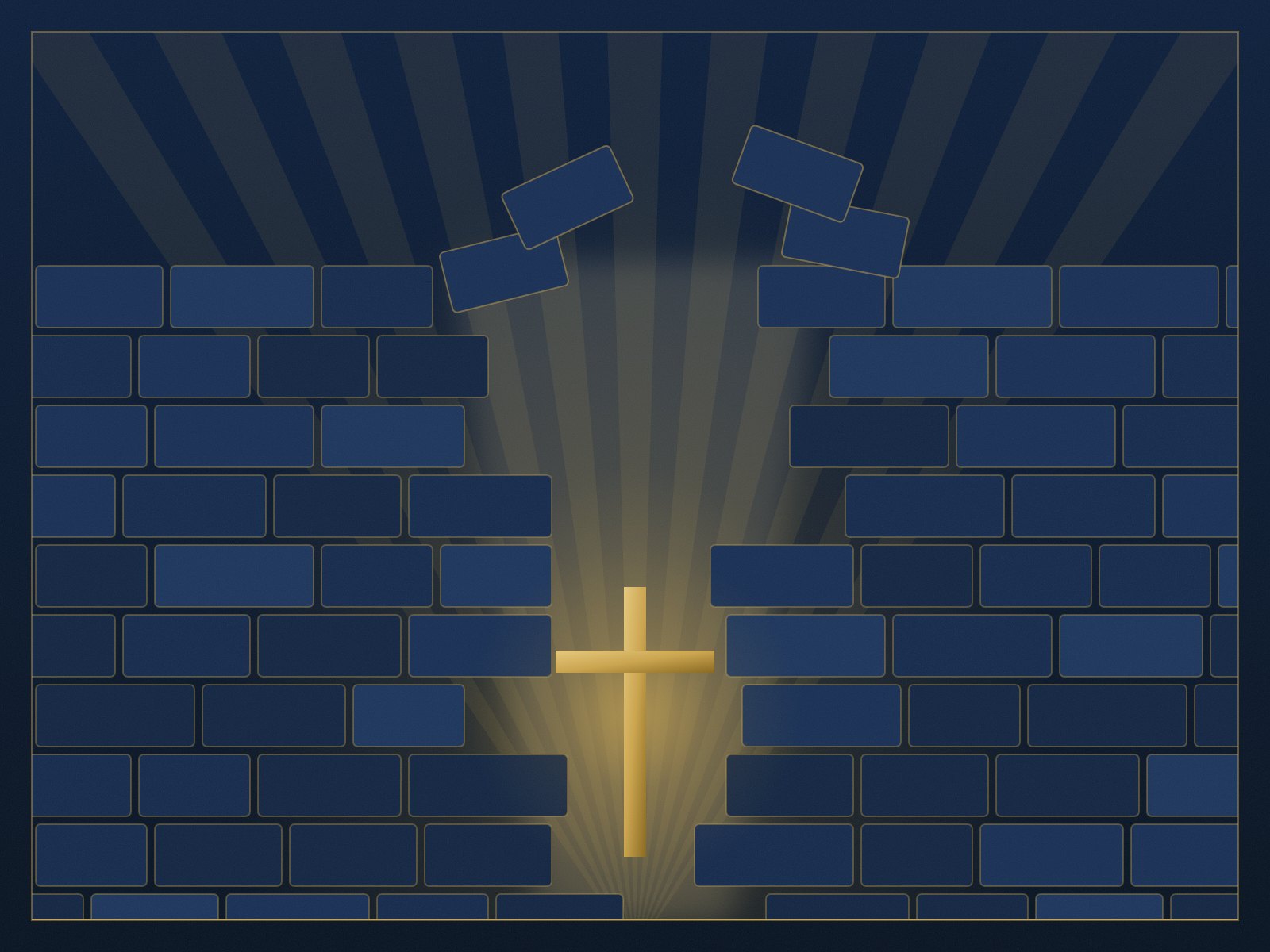
The Walls We Called Holy
In 1914, Robert Frost published a poem about two neighbors who meet every spring to rebuild the stone wall between their properties. One neighbor has a single answer for why the wall matters: "Good fences make good neighbors." It's something his father used to say. The narrator isn't so sure. There are no cows to keep in, nothing to keep out. So he offers a better question:
"Before I built a wall I'd ask to know / What I was walling in or walling out, / And to whom I was like to give offense."
The neighbor never answers. He just keeps stacking stones, because his father stacked stones, and it never occurs to him to ask why.
I have been thinking about that poem in light of the church, because the church is a skilled builder of walls. We build them carefully, with good intentions, and we repair them every season. Most of us never ask what we are walling in or walling out. We inherited the wall. Somebody we loved and trusted told us the wall was holy, and so we keep stacking.
Some of those walls are holy. Scripture draws lines, and the church that refuses to draw any lines at all is not a church. It is a crowd. But not every wall we defend was built by God. Some were built out of honest differences in how faithful people read the Bible. Others were built from something harder to admit: the historical and personal biases of the people who handed us our faith, which we absorbed so completely that we can no longer tell the difference between their fear and God's Word.
Those walls have cost the church dearly. They have cost us people, and they have cost us witness. The tragedy is that many of us don't even recognize them as walls. We think they are part of the foundation.
At Antioch, we spent the month of August in a sermon series called Holy Tension: Faith for the Questions We'd Rather Avoid. We asked three questions. Did the Spirit stop working, or did we stop expecting Him to? What does Scripture actually say about women in leadership? And what does Peter's vision in Acts 10 mean for our LGBTQIA+ brothers and sisters in the faith? Three very different questions. But underneath all of them was the same one Frost's narrator asked: what are we walling out, and who gave us permission?
Not Every Tradition Is a Wall
Before we take down anything, we need to be honest about what deserves to stand.
I am a pastor in a historically Black Baptist church, and I love tradition. I love the hymns lined out by the deacons. I love the order of service my father kept and the one I have kept, with my own adjustments. Tradition is how one generation hands its faith to the next. It is memory with a pulse. Even Jesus went to the synagogue on the sabbath day, Luke tells us, "as was his custom" (Luke 4:16). Healthy tradition is not the enemy of the Spirit. It is often the vessel the Spirit uses.
But Jesus also confronted religious leaders who had confused the vessel with what it was meant to carry. Quoting Isaiah, He said of them, "in vain do they worship me, teaching human precepts as doctrines. You abandon the commandment of God and hold to human tradition" (Mark 7:7–8, NRSV). Jesus never condemned tradition itself. He condemned tradition that had been promoted to the level of revelation, tradition that had started doing God's job.
That is how a wall gets built. A practice becomes a preference. A preference becomes a pattern. A pattern becomes "the way we've always done it," and somewhere along the way, "the way we've always done it" becomes "the way God said it must be done." Nobody ever stands up and says, "Let's add something to Scripture." It happens one generation at a time, and the people stacking the stones sincerely believe they are being faithful.
A pastor and mentor once said something to me that I have never been able to shake: "Most people are staunch in their beliefs so as not to offend who taught them. Their loyalty isn't to the lesson, but to the teacher." Loyalty is a virtue. The Black church was built on it. But when our loyalty is to the teacher rather than the lesson, we can inherit someone else's limitation and mistake it for revelation.
Here is the irony for those of us in the Baptist tradition. Our own heritage gives us permission, even obligation, to examine what we've inherited. Walter Shurden summarized the historic Baptist principles as four freedoms, and the first of them is Bible freedom: every believer has the responsibility to read and interpret Scripture under the guidance of the Holy Spirit. The second is soul freedom: every person is directly accountable to God. Baptists were never meant to be people who simply received the walls. We were meant to be people who go back to the text and ask whether the wall belongs there.
So that is the task. Not to tear down every tradition. To ask of each one: is this barrier God's, or is it ours?
Walls Built from Discomfort
The first wall we examined in Holy Tension didn't look like a wall at all. It looked like good Baptist order.
Many churches in my tradition have absorbed some version of cessationism, the belief that the miraculous gifts of the Spirit (tongues, prophecy, healing, miracles) ceased with the apostles. The canon is closed, the argument goes, and we no longer need signs and wonders. Even churches that have never heard the word cessationist often operate by its logic. Somebody speaks in tongues and the person next to them leans over and whispers, "What did they say?" Somebody testifies that God healed what the doctors couldn't, and we clap on Sunday but don't quite believe it by Tuesday.
But when Paul lists the gifts of the Spirit in 1 Corinthians 12, he doesn't sort them into the permanent and the temporary. He puts wisdom and healing and prophecy and tongues in the same sentence, distributed by the same Spirit, "just as the Spirit chooses" (1 Corinthians 12:11). Nowhere does the text tell us that some of these would expire. That idea had to be brought to the text.
I have come to believe that cessationism is often less a conclusion drawn from Scripture than a strategy for managing discomfort. That is a pattern worth naming, because it shows up again and again. When we don't know how to handle something, we build a barrier so we never have to experience it. We take what unsettles us and declare it closed.
Even our favorite verse for keeping order has been pressed into service as a wall. "All things should be done decently and in order" (1 Corinthians 14:40) has been quoted to regulate everything from what people wear to what time service ends. But read the verse before it: "So, my friends, be eager to prophesy, and do not forbid speaking in tongues" (14:39). Paul's call for order comes attached to a command not to shut the gifts down. Order was meant to let the whole body receive the Spirit's work without confusion. We turned it into a reason to keep the Spirit at a comfortable distance.
This matters beyond spiritual gifts, because it shows us how walls work. They rarely announce themselves as walls. They show up dressed as reverence, as decency, as respectability. And the people they keep out, in this case the Spirit's own work in the gathered church, are kept out so politely that we never notice the door was closed.
Walls Built on a Single Word
The second wall is older and has done more visible harm.
For generations, 1 Timothy 2:12 has been one of the most effective walls the church has ever built: "I permit no woman to teach or to have authority over a man; she is to keep silent" (NRSV). That single verse has removed women from pulpits, stripped them of titles, and told them the call they know is on their lives doesn't count. Most of us were handed that verse long before anyone taught us how to read it.
This is a wall rooted, at least in part, in a real difference of interpretation. Faithful scholars land in different places. But when we slow down and actually study it, the wall begins to look much less like bedrock.
Paul wrote this letter to Timothy, who was pastoring in Ephesus, a city dominated by the worship of Artemis, whose temple was one of the Seven Wonders of the Ancient World and whose cult was led largely by priestesses. Acts 19 records an entire city shouting "Great is Artemis of the Ephesians!" for two hours. The letters to Timothy describe a specific, local crisis of false teaching spreading through households. Context does not erase a text, but it tells us what the text was addressing.
Then there is the word itself. The phrase "have authority over" translates a single Greek word, authenteō, which appears exactly once in the entire New Testament. When Paul speaks positively about leaders elsewhere, elders who "rule well" or those who "have charge over you," he uses ordinary words for leading. Authenteō is different. In the rare ancient sources where it appears, it carries the sense of domineering, of forcing one's will on another. Even the King James translators in 1611, centuries before modern debates about women in ministry, rendered it "usurp authority." Not hold authority. Usurp it.
And notice how Paul introduces the instruction: "I permit no woman." Not "the Lord commands." In 1 Corinthians 7, the same apostle takes care to distinguish between a command of the Lord and his own judgment: "To the rest I say — I and not the Lord" (7:12). The text doesn't force us to read "I do not permit" as a pastoral ruling for one church in one city. But it should stop us from treating one man's "I" as God's eternal "thou shalt not" for every woman in every century.
Most of all, the wall doesn't match the rest of Scripture. Deborah judged Israel without a word of apology from the text (Judges 4:4). Miriam led the whole community in worship after the Red Sea and is called a prophet (Exodus 15:20). Paul commends Phoebe as a diakonos, a deacon, and most likely entrusts her with carrying his letter to the Romans (Romans 16:1). Priscilla instructed Apollos, a gifted and already preaching man, in the way of God (Acts 18:26). Paul assumes in 1 Corinthians 11:5 that women will pray and prophesy aloud when the church gathers. The women at the tomb were the first preachers of the resurrection. And at Pentecost, Peter explained the outpouring of the Spirit by quoting Joel: "your sons and your daughters shall prophesy" (Acts 2:17).
So we have to ask the question that makes everyone uncomfortable: is this really about faithfulness to the text, or is it about control? When we build an entire doctrine on one rare word in one letter to one city, and quietly step around Deborah, Miriam, Phoebe, Priscilla, and the women of Pentecost, we may be protecting something other than Scripture. We may be protecting comfort, familiarity, and power staying where it has always been.
If a woman could carry the Word in her womb, why can't she carry it in her mouth?
Walls Built from Inheritance
That question leads us somewhere the Black church knows painfully well.
The church has a long history of deciding who is permitted to serve, and of being wrong about it. We have excluded people of certain races from certain roles, citing Scripture. We have excluded women from the pulpit, citing Scripture. We have drawn hard lines around the divorced, the addicted, and the broken. In most of those cases, the church eventually recognized that the barrier was ours and not God's. We had taken our reading of the text, built a wall with it, and called the wall holy.
The Black church does not have to imagine what that looks like. We were on the other side of the wall. In 1807, a missionary society in London published an edited Bible for enslaved people in the British West Indies, with most of the Exodus story removed. They kept the verses that told slaves to obey their masters. They cut the story of a God who hears the cry of the oppressed and brings them out of bondage. Those who edited it believed they were spreading the gospel. What they were actually doing was protecting an economic and racial order and calling it Christianity.
Enslaved people on this side of the Atlantic, handed the same kind of preaching, read past the wall. They found Moses anyway. They sang "Go Down, Moses" in the fields and found a God who was not on Pharaoh's side. The Black church was born, in a very real sense, out of people refusing to accept a reading of Scripture designed to keep them in their place.
That is our inheritance. It means we, of all people, should be suspicious when the Bible is read in ways that conveniently keep certain people at a distance. We know from experience that sincere Christians can build walls out of their own biases and genuinely believe God laid every stone.
It also means we have to ask the harder question of ourselves. If our ancestors could see the wall that was built around them, what walls have we built around others?
Reading the Hardest Texts Honestly
This brings us to the conversation the church most wants to avoid: the place of our LGBTQIA+ brothers and sisters in the life of the church.
In August, Antioch released a pastoral statement on human dignity, belonging, and ministry participation regarding LGBTQIA+ persons. I want to be careful here about what that statement does and does not do, because integrity requires it.
The statement does not attempt to settle the question of whether LGBTQIA+ identity or expression is sin. That is a serious question, and it deserves its own time and pastoral care. Faithful people who love God and take Scripture seriously have read the same texts and arrived at different conclusions on it, within our congregation, within the Baptist tradition, and throughout the global church. This is not a battle between people who take the Bible seriously and people who don't. It is a conversation among people who all take the Bible seriously and are arriving at different places.
What we owe one another is honest work with the texts. So let me show it, briefly.
Genesis 1–2. The traditional reading sees the union of male and female in creation as God's design for human sexuality. Contemporary scholarship acknowledges that pattern while noticing something prior to it: before the text says anything about gender, God breathes into the dust and the human becomes a living soul, nephesh. If God is not a man (Numbers 23:19) and God is Spirit (John 4:24), then the image of God in humanity cannot be primarily about gender or sexuality. Soul precedes sex.
Genesis 19. Sodom has long been cited as judgment on same-sex behavior. But Scripture offers its own commentary: "This was the guilt of your sister Sodom: she and her daughters had pride, excess of food, and prosperous ease, but did not aid the poor and needy" (Ezekiel 16:49, NRSV). Many scholars read the story as judgment on violent inhospitality and exploitation, not consensual relationship.
Leviticus 18:22 and 20:13. These are read traditionally as clear and enduring prohibitions. But every Christian has to answer a question about the Holiness Code: by what principle do we carry some of its laws forward and release others? We don't keep its dietary laws, its fabric restrictions, or its civil penalties. An honest reading has to name the principle we use.
Romans 1:26–27. This is the most cited New Testament text in the conversation. The traditional reading sees a clear condemnation of same-sex behavior as contrary to nature. Contemporary scholarship places it within Paul's indictment of Gentile idolatry and argues that he is describing excess, exploitation, and the abandonment of God. Committed same-sex covenant relationships were not a recognized category in his world.
1 Corinthians 6:9 and 1 Timothy 1:10. These hinge on two Greek words, arsenokoitai and malakos, rendered very differently across translations. The King James translates malakos as "effeminate." The NRSV renders the words "male prostitutes" and "sodomites." The updated NRSVue translates arsenokoitai as "men who engage in illicit sex" and adds a footnote that reads simply: "Meaning of Greek uncertain." That footnote is not the conclusion of advocates. It is the admission of the translators themselves.
I offer these readings not to suggest that the conversation has no stakes. It has enormous stakes. I offer them because a church that has been told the answers are simple is less prepared to love across difference than a church willing to sit with the real complexity of the text.
Here is where interpretation and bias meet. When the texts are honestly contested, when translators themselves admit uncertainty, why has the church been so certain about keeping people out? Why have we reserved our most confident judgments for the people we were most uncomfortable with? That is not a question about interpretation anymore. That is a question about us.
And while the sin question remains open, the questions that come before it do not. Every person is made in the image of God. Salvation belongs to all who trust in the finished work of Jesus Christ, and nothing else. And "the gifts and the calling of God are irrevocable" (Romans 11:29). If God has gifted and called a person, that gift and calling do not dissolve because of who that person loves. We do not believe we have the authority to close a door God has opened.
The statement also holds two commitments together that many people assume must be pulled apart: a high view of Scripture and a high view of lived experience. Some hear that and worry we've placed experience over the Bible. But the Bible itself shows us the church making exactly this kind of discernment. When Peter returned to Jerusalem and was criticized for eating with Gentiles, he didn't win the argument with a new verse. He told them what he had seen in Cornelius's house: "If then God gave them the same gift that he gave us when we believed in the Lord Jesus Christ, who was I that I could hinder God?" (Acts 11:17, NRSV). And at the Jerusalem Council, the church weighed Peter's testimony, and that of Paul and Barnabas, about what God was doing among the Gentiles alongside the Scriptures (Acts 15). The same Spirit who inspired the text was moving in the people they were reading it alongside.
None of this requires anyone to abandon their convictions. It requires us to ask whether our convictions have become a wall.
Common or Communion
Which brings us back to Acts 10, where the question of walls was settled once before.
Peter was a faithful man. He had walked with Jesus in the flesh, watched the miracles, seen the risen Lord. And when God showed him a sheet full of animals the law had called unclean and said, "Get up, Peter; kill and eat," Peter refused. "By no means, Lord," he said, "for I have never eaten anything that is profane or unclean" (Acts 10:14). Peter told God no and called it devotion. Three times.
God answered, "What God has made clean, you must not call profane" (10:15). And when Peter arrived at the house of Cornelius, a Roman centurion whose prayers and generosity God had already honored, he finally understood. The vision was never about food. It was about people. "God has shown me," he said, "that I should not call anyone profane or unclean" (10:28).
The Greek word translated "unclean" there is koinos, and its most basic meaning is simply "common," ordinary, outside what is set apart. The King James renders it, "I should not call any man common or unclean." But that same root gives us one of the most treasured words in the New Testament: koinonia. Fellowship. Communion. Deep, shared life.
The very word that had been used to keep people at a distance shares a root with the word for the deepest kind of belonging. God was never asking Peter to lower the standard of holiness. He was asking Peter to stop mistaking exclusion for holiness. The same root that built a wall could just as easily build a table.
And notice the order of events. God spoke to Cornelius before God ever spoke to Peter about him. God was already moving toward the person Peter had written off. Peter wasn't opening a door God had closed. He was catching up to a door God had already opened.
That is the hope and the warning of every wall we build. God is not confined by them. The Spirit is already on the other side, already moving among the people we've kept out, already pouring out gifts we have no authority to revoke. The only question is whether we will be like Peter, humble enough to admit we were wrong, or like Frost's neighbor, stacking stones because our fathers stacked stones.
The Main Thing
So how should a church decide what to keep and what to take down?
I have come to hold two New Testament texts as the primary measures of faithfulness. In Matthew 25, when Jesus describes how He will judge the nations, He does not ask about doctrinal precision. He asks whether we fed the hungry, gave water to the thirsty, welcomed the stranger, clothed the naked, cared for the sick, and visited the imprisoned. The judgment seat is not a theology exam. It is an accounting of how we loved. And in Galatians 5, when Paul describes the evidence of a life surrendered to the Spirit, he names love, joy, peace, patience, kindness, generosity, faithfulness, gentleness, and self-control. Not uniformity on every contested question. Fruit.
These texts don't settle every debate. But they tell us clearly what the main thing is, and the main thing is love.
Years ago, in a rough season of my life and ministry, I sat in a conference session and heard a woman preach in a way that broke me open. I could not tell you today exactly what she said. I can tell you that I wept uncontrollably, and that the Holy Spirit met me through her in a way I needed more than I knew. In the very next session, I learned that she is a same-gender-loving woman married to a woman. And I sat there with a question I didn't choose and couldn't shake: did what God had just done in me get undone by what I had just learned about her?
I'm not going to pretend I resolved that question that afternoon. But I know what the Spirit did in that room was real. It didn't become less real when I knew more about her. And I learned that day that my approval was not required for God to use her.
That is the lesson of every wall in this essay. The Spirit did not need cessationists' permission to keep moving. God did not need the church's permission to call Deborah, Phoebe, and Priscilla. God did not need Peter's permission to save Cornelius. And God does not need ours.
What God asks of us is not permission. It is room.
There is a better wall-builder in Scripture than any of us. Paul writes that Christ "is our peace; in his flesh he has made both groups into one and has broken down the dividing wall, that is, the hostility between us" (Ephesians 2:14, NRSV). The cross was not God building a wall to keep the wrong people out. It was God tearing one down so that people who were far off could be brought near. Every wall the church builds in the name of holiness has to answer to that one: the wall Jesus broke down with His own body.
Frost's narrator had it right: "Something there is that doesn't love a wall, / That wants it down." I believe that something is the Spirit of God. And I believe that the church that wants to recover its witness in this generation will have to do what Peter did on the rooftop in Joppa: stop arguing with God, admit what we inherited, go to the house we were taught never to enter, and discover that God got there first.
Land where you land on the questions that remain. But love how Jesus loves.
That is not the absence of a standard. It is the highest one we have.